10 unusual things to see in Venice: The City’s Most Curious and Lesser-Known Places
Venice is a city that continues to surprise even those who think they know it well. Beyond St Mark's Square, the Rialto Bridge and the palaces overlooking the Grand Canal, there are places that tell a completely different story of the city: ancient hospitals, monumental cemeteries, flooded crypts, science museums and even a historic airport.
Some are hidden among the narrow streets of the historic centre, while others are located on the islands of the lagoon or at the Venice Lido, far from the busiest tourist routes.
If you’re looking for unusual things to see in Venice, here are ten fascinating places worth discovering, filled with lesser-known stories, remarkable architecture and unexpected curiosities.
1. The Flooded Crypt of the Church of San Zaccaria
Just a few steps from St Mark’s Square, the Church of San Zaccaria hides a space that seems to belong to another Venice.
Beneath the chapels of the ancient church lies a crypt, probably dating back to the 10th century, divided into three small naves supported by columns. What makes it particularly unusual is that, for much of the year, its floor is submerged by water due to the tides.
The vaults and columns are reflected on the water’s surface, creating an evocative, almost surreal atmosphere. It is a striking reminder of the relationship Venice has maintained with its lagoon for centuries, revealed here in a truly unusual way.
The crypt is part of the church’s museum itinerary and can be visited with a separate admission ticket. Access conditions may vary depending on the tides.
2. The Andrea Vesalio Museum of Pathological Anatomy: Two Centuries of Venetian Medicine
Not everyone knows that within the complex of Venice’s Civil Hospital, at the Scuola Grande di San Marco, there is a museum dedicated to the history of pathological anatomy.
The Andrea Vesalio Museum houses a collection of anatomical specimens and scientific preparations documenting almost two centuries of hospital activity. The exhibits include bone specimens, preserved anatomical preparations and materials that help reconstruct the diseases and living conditions of Venice’s population.
Particularly interesting is the connection between certain diseases and traditional activities in the lagoon, such as glassmaking.
It is an unusual place that offers a perspective on the city’s history through medicine, science and the living conditions of its inhabitants. The museum is open to visitors on selected days.
3. Nicelli Airport: A Journey into 1930s Aviation at the Venice Lido
At the Venice Lido, there is an airport that seems frozen in the 1930s. It is Giovanni Nicelli Airport, located in the San Nicolò area, one of the island’s most surprising landmarks.
Already operating for civil aviation in 1926, the airport was one of Italy’s most important airfields during the early decades of air travel. In 1935, the passenger terminal, designed by architect Mario Emmer, was inaugurated.
The building retains the charm of Rationalist architecture, with interiors, furnishings and decorations that evoke the elegance of that period. Inside, visitors can also find reproductions of aviation-themed works by the Futurist artist Tato.
Today, Nicelli Airport is still operational and also houses a restaurant. It is a fascinating place to discover during a visit to the Lido, especially for enthusiasts of architecture and aviation history.
To learn more, discover the history of Nicelli Airport.
4. The San Servolo Psychiatric Hospital Museum: The History of a Forgotten Island
A short distance from Venice’s historic centre lies San Servolo, an island that for centuries housed religious and charitable institutions and, until 1978, a psychiatric hospital.
Today, part of this history is told in the Psychiatric Hospital Museum, known as La follia reclusa (Confined Madness), which preserves documents, photographs, medical instruments and objects belonging to the institution.
The exhibition also explores the more difficult aspects of the history of psychiatric care, through restraint devices, evidence of the treatments once used and objects made by patients.
The visit also includes historic spaces such as the 18th-century pharmacy and the anatomical room.
It is a very different experience from Venice’s traditional museums, encouraging visitors to reflect on the evolution of medicine and the treatment of mental illness.
5. Palazzo Tetta: The Venetian House Surrounded by Water on Three Sides
In Venice, almost every building overlooks a canal, but few occupy a position as unusual as Palazzo Tetta.
In the Castello district, at the intersection of Rio di San Giovanni Laterano and Rio de la Tetta, stands this building surrounded by water on three sides. Its elongated shape and position where the canals meet make it look like a small island in the heart of the city.
The best place to admire it is Ponte dei Conzafelzi, a bridge offering a clear view of the building’s unusual geometry.
It is not a museum or a palace open to visitors, but rather an architectural curiosity to discover while wandering through the quieter streets of Castello.
6. The Ancient Jewish Cemetery of the Lido: A Place Suspended in Time
Among the quietest corners of the Venice Lido, in the San Nicolò area, lies a place that tells an essential part of Venetian history: the Ancient Jewish Cemetery.
Its origins date back to 1386, when the Republic of Venice granted the Jewish community a plot of land for burials.
Over the following centuries, the cemetery suffered damage, underwent changes and experienced long periods of abandonment. Its ancient gravestones, many decorated with inscriptions and symbols, gradually became surrounded by vegetation.
An important restoration project, launched in 1999, made it possible to restore and catalogue more than a thousand gravestones, bringing renewed attention to one of the most significant sites of Venetian Jewish heritage.
Today, the ancient cemetery can be visited during scheduled openings and organised guided tours. It is a place to explore with respect, particularly interesting for anyone wishing to learn more about the history of the communities that have lived in Venice.
Discover more about the Ancient Jewish Cemetery of the Lido.
7. Lazzaretto Nuovo: The Island Where Venice Quarantined Goods and Travellers
In the northern lagoon, not far from Sant’Erasmo, there is an island that reveals one of the lesser-known aspects of how the Venetian Republic was organised.
This is Lazzaretto Nuovo, used from the 15th century onwards for health inspections and quarantine procedures involving goods and travellers arriving in the lagoon.
Within its surrounding walls stands the Tezon Grande, a large building once used for storing and treating goods. Its walls still preserve ancient graffiti documenting daily life and activities on the island.
Today, Lazzaretto Nuovo is an ecomuseum combining history, archaeology and the natural environment. The visitor route includes archaeological excavations and the Sentiero delle Barene, a trail offering the chance to explore the lagoon landscape and its salt marshes.
The island can only be visited on guided tours booked in advance, according to a seasonal schedule.
8. A Seven-Metre Dinosaur Hidden Inside a Venetian Palace
Who would expect to find a dinosaur in the heart of Venice?
Inside the Fontego dei Turchi, overlooking the Grand Canal, the Giancarlo Ligabue Natural History Museum houses an almost complete skeleton of Ouranosaurus nigeriensis, a herbivorous dinosaur measuring more than seven metres in length.
The specimen comes from the scientific expedition organised by Giancarlo Ligabue in the Ténéré Desert, Niger, between 1972 and 1973.
The collections also include the skull of the giant prehistoric crocodile Sarcosuchus imperator, while the ground floor displays the skeletons of large cetaceans.
It is a surprising experience for anyone wishing to combine visits to Venice’s monuments with a journey through natural history, and is particularly appealing to families with children.
9. The Oratorio dei Crociferi: A Hidden Artistic Treasure in Cannaregio
In Campo dei Gesuiti, in the Cannaregio district, stands a rather unassuming building that conceals an extraordinary artistic heritage.
This is the Oratorio dei Crociferi, part of an ancient charitable complex founded in the 12th century to provide hospitality and assistance to pilgrims and travellers.
Between 1583 and 1592, the painter Jacopo Palma il Giovane created a cycle of paintings covering the oratory’s walls and ceiling, depicting episodes connected to the Order of the Crociferi and Venetian history.
The result is a small room completely enveloped in paintings, hidden behind a façade that gives little indication of the artistic richness inside.
It is an unexpected stop for those who enjoy discovering Venetian art beyond the city’s most famous museums and churches.
10. The Crypt of the Tempio Votivo: The Hidden History Beneath a Great Dome at the Lido
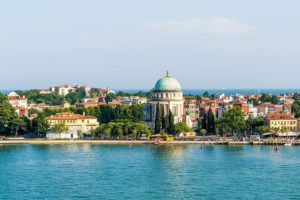
Visitors arriving at the Venice Lido via Santa Maria Elisabetta may notice the great dome of the Tempio Votivo, which dominates a stretch of the waterfront overlooking the lagoon.
Not everyone knows, however, that beneath the building lies a monumental crypt serving as a military memorial.
The construction of the temple originated from a vow made in 1916 by the Patriarch of Venice, Pietro La Fontaine, during the First World War. Work began in 1925, and in the following years the crypt became a burial and remembrance site for those who died in the two World Wars.
Inside, among black marble columns and memorial niches, are also the remains of Nazario Sauro.
The crypt can be visited on the days when the military memorial is open, while the upper part of the building is not normally accessible to the public.
To learn about its history and visiting arrangements, explore the page dedicated to the Tempio Votivo at the Venice Lido.
Discover a Different Side of Venice, Between the Historic Centre and the Lido
These ten places show just how much more complex and surprising Venice is than the image conveyed by its most famous monuments.
Simply choosing a different route can lead to traces of different eras, forgotten stories and hidden corners that still preserve a special connection with the past and the lagoon.
The Venice Lido is part of this rich heritage. Beyond its beaches and the Venice Film Festival, the island is home to historic sites, 20th-century architecture and cultural landmarks that deserve to be explored at a leisurely pace.
One more reason to spend some time on the island and discover a lesser-known side of Venice.

Venice Film Festival 2027: Official Dates Announced for the 84th Edition
Venice Carnival 2027: dates, traditions and magic between Venice and the Lido