Carnival and Olympics: Venice and Cortina between tradition, sport and territory

In 2026 Venice and Cortina will be protagonists of an interweaving of events and suggestive moments that will bring together two apparently distant worlds: the lagoon city, with the magic of Carnival, and the Queen of the Dolomites, stage of the Winter Olympics.
The meeting point? Not only the new infrastructures and tourist strategies, but also unique phenomena such as the “stravedamento”, the Munich-Venice cycle route and a shared set of historical and cultural values.
Between calendar and territory: when Carnival and the Olympics meet
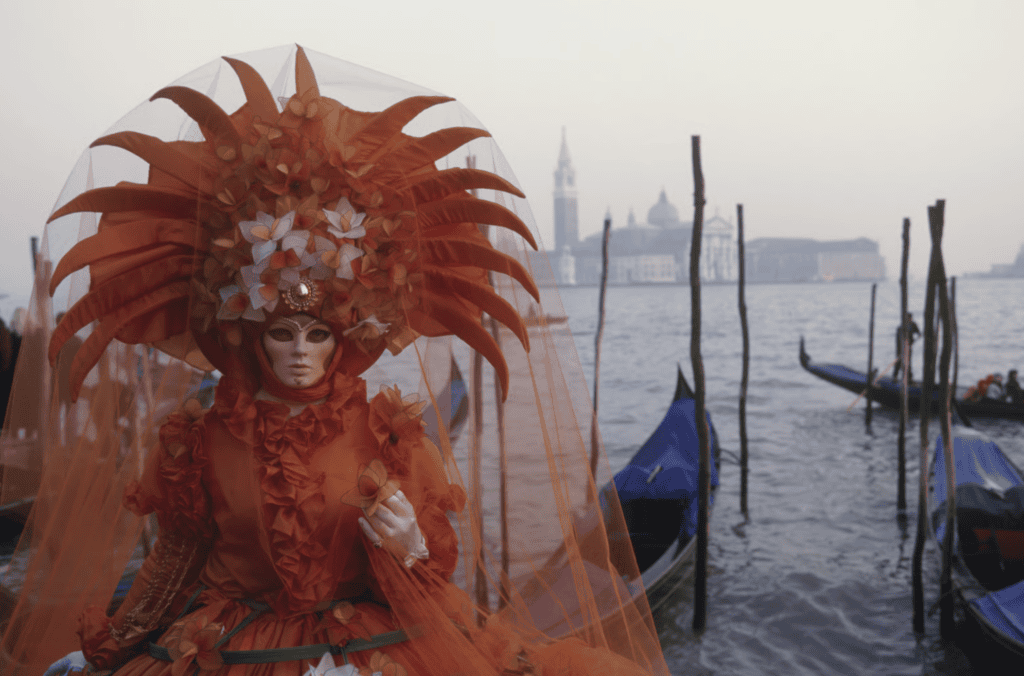
The 2026 calendar will offer a very rare overlap: the Carnevale di Venezia – one of the oldest, most spectacular and best-known in the world – will be held from 31 January to 17 February, significantly earlier than usual. A few days later, on 6 February, Cortina d’Ampezzo will host the opening ceremony of the 2026 Winter Olympics Milano-Cortina, projecting the entire territory into the heart of the international scene. This temporal contiguity has inspired both tourist operators and institutions to promote integrated packages and initiatives, enhancing a dual attraction capable of stimulating tourism, culture and mobility between mountain and lagoon.
The “stravedamento”: a visual bridge between Lagoon and Dolomites
One of the most poetic natural phenomena that ideally unites Venice and Cortina is the “stravedamento”: on rare winter days, when the clear Bora wind blows and the air becomes crisp and dry, the Dolomites become visible from the Venetian lagoon with surprising details, sometimes identifiable one by one at more than 100 kilometres’ distance. This is not a photo-montage, but pure physical reality: the clarity depends on exceptional meteorological conditions and the use of telephoto lenses which compress distances, making the Venetian horizon and the profiles of the Dolomite peaks almost coincide. This event thus becomes a powerful visual and literary metaphor of a deep and ancient bond between city and mountains that no distance can erase.
The stravedamento also evokes images that unite gondolas and snow-capped peaks, the Basilica dei Frari with the Pale di San Martino: a spectacle visitors can try to glimpse during their stay.
Carnival 2026: Venice as a mirror of Olympic values
The theme chosen for Carnival of Venice 2026 will be “Olympus – At the origins of play”: a tribute to the values of sport and competition, guiding threads that connect mythological classicism, popular play and Olympic modernity. The 2026 edition will explicitly celebrate the Olympic year, retracing Venice’s history as a stage for races, acrobatic shows, tournaments, regattas — in a city where challenge and festivity have been intertwined for centuries. Carnival thus becomes a cultural echo of the Games in Cortina, making acrobats and athletes, masks and skiers live together in the same historical and emotional framework, in a coherent narrative of passion, courage, inclusion and beauty.
New connections and infrastructure
The link between Venice and Cortina will be further strengthened in 2025-26 thanks to new infrastructures that will make tourist intermodality and mobility between the two locations ever more fluid. The completion of the new railway line Venezia Marco Polo railway line – already under construction and in advanced phase – will be operational from December 2025, in time for the Olympics. This will allow tourists to reach Cortina by train directly from the Venetian airport, reducing travel times and encouraging sustainable forms of travel. These connections will be supported by targeted marketing campaigns such as “Just 2 hours away from here!”, designed to emphasise the proximity between lagoon and Dolomites even to international visitors.
The Munich-Venice cycle route: a green way between Olympic venues
The Munich–Venice cycle route represents another physical and symbolic red thread between the world of the lagoon and the mountains. This spectacular itinerary of over 550 km links three major Olympic cities: Munich, Innsbruck and Cortina, then descends towards Venice. The route crosses grand alpine scenery, passes through the Conca Ampezzana (site of Olympic competitions already in 1956 and again in 2026), the Cadore, Belluno, Treviso and arrives in the Serenissima. It is the only cycle-path in the world to connect three Olympic locations and offers a unique travel proposal for Italian and foreign cycle-tourists, increasingly attracted by sustainability themes and the possibility of experiencing the history of sport by pedalling literally “between the Olympics”.
Integrated tourism and new economic opportunities
The combined effect of Olympics and Carnival is expected to be disruptive also from the point of view of economy and tourist reception. Destination tourism, as well as the international flows drawn by the two events, will find a territory ready not only to receive, but to offer packages, cultural initiatives, sporting events and opportunities for integrated visits between sea, lagoon, mountains and ski slopes. Regional institutions, starting from the tourist information offices “Le Porte dell’Accoglienza”, are already engaged in this relaunch path with a coordinated image, widespread events and a specific investment for the enhancement of rail, road and cycle links. From a long-term perspective, these actions aim not only to attract visitors for a few days, but to consolidate the Venice–Dolomites pair as a model of experiential and widespread tourism that values the plurality and quality of the Venetian heritage.
2026 will be the year in which Venice and Cortina present themselves to the world as cross-points of culture, sport, beauty and innovation. Carnival and Olympics will become the two faces of a medal that tells of openness, shared history and the ability to welcome the future without forgetting the strength of traditions and landscapes. Natural phenomena such as the stravedamento will become a visual metaphor of this connection, while new links and thematic routes such as the Munich-Venice cycle route will make the journey between lagoon and Dolomites not only easier, but also exciting. Those who visit Venice or Cortina between January and February 2026 will be able to live both dimensions, and perhaps discover that the real spectacle begins when city, mountains, history and future mirror one another continuously.
Venice Carnival 2027: dates, traditions and magic between Venice and the Lido
Venice Film Festival 2026: the Venice 83 programme unveiled