A few days before Halloween, the tale of the ghost island
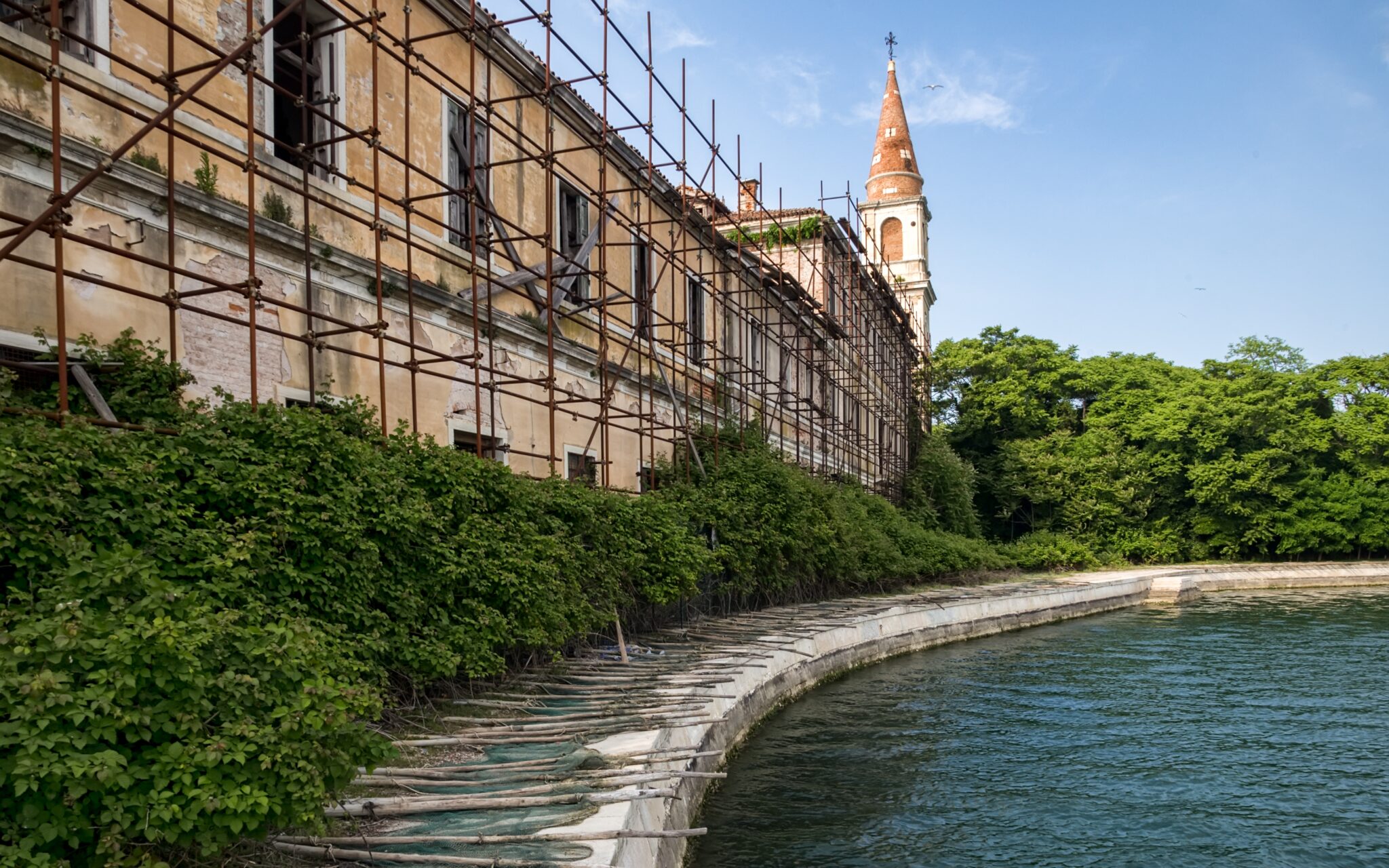
Poveglia has for years been shrouded in an aura of mystery and legend, often described as Venice’s cursed island, a forgotten place that no one seems willing to take care of. Yet, something has recently changed.
Located south of the lagoon, facing Malamocco, Poveglia appears as a small archipelago composed of three islands, one of which is artificial. The central island, the largest, hosted over the centuries most of the buildings and is connected by a bridge to a smaller one. The artificial islet, called Ottagono for its geometric shape, was built in 1380 for defensive purposes.
In ancient maps, the place is indicated with different names, such as Poveggia or Popilia, perhaps in reference to the poplar trees that grew there or to the nearby Via Popilia-Annia, the road built by the Roman consul Publius Popilius Lenate. The history of Poveglia is intertwined with myths, rumors, and suggestions born from the abandonment and silence that for decades have surrounded its ruins.
Many legends have been handed down over time, also fueled by television programs dedicated to the paranormal, though without any certain historical basis. It is said that during the Black Plague, thousands of the sick were taken to the island to be burned and buried, and that the ground today is partly made of their ashes. Another story tells of the tragic fate of the director of the psychiatric hospital, described as a cruel doctor, who is said to have taken his own life by throwing himself from the bell tower, driven by the spirits of his victims. A witness, a nurse of that time, allegedly recounted that he did not die on impact, but was suffocated by a dense and unreal fog rising from the ground. From these tales arises the dark fame of the island, once a place of isolation for plague victims and, according to some voices, the site of an asylum disguised as a nursing home for the elderly.
Today, however, Poveglia is not only a memory of fear and abandonment. After eleven years of mobilization, the association Poveglia per Tutti has obtained the concession of the North Island, launching a regeneration project based on sustainability, participation, and collective responsibility. The concession, at a reduced rent, represents the recognition of an effort lasting years, founded on the desire to bring life and meaning back to a symbolic place of the lagoon.
Visiting Poveglia remains a fascinating and complex experience, recommended for those who love adventure and discovery. The lush vegetation and crumbling buildings make the route difficult, but also full of suggestion. Of the ancient Pieve di San Vitale only the bell tower survives, spared from sieges because it was used as a lighthouse. The tower, topped by a clock without hands dating back to 1745 and made by Bartolomeo Ferracina, is still today the highest point of the island.
The church once housed a 15th-century crucifix in plaster and stucco, considered miraculous and now kept in the parish church of Malamocco. Other artworks, such as Christ Led to Calvary by Giulia Lama and The Miracle of the Crucifix by Giovanni Battista Piazzetta, have been lost.
Today Poveglia is a place suspended between nature and ruin, where vegetation has reclaimed the spaces and where silence is broken only by the wind and the sound of the water. The main buildings, including the hospital, kitchens, and bell tower, can be visited only partially and with great caution. The rooms are empty and dark, the floors unsafe, the stairs in ruin. A flashlight and a steady step are indispensable for those who wish to explore the remains of a past that still seems to breathe.
Venice Carnival 2027: dates, traditions and magic between Venice and the Lido

Venice Film Festival 2026: the Venice 83 programme unveiled